|
The Meadowlark Gallery,
Inc. |
||
|
E. W. Gollings a.k.a.
Bill Gollings (1878-1932) |
||
![]() ![]() |
Order now!! "Gollings, More of the Story" by Trade edition of 2000 copies with book plates signed
by the authors. Reproduction of 179 oils, 39 watercolor or mixed media, 30 graphite, 24 pen and ink, 17 Christmas Cards, 1 linoleum cut, 55 photographs, 26 images of ephemera, 16 commercial examples, 1 sculpture, and signature examples from 1900 to 1932. Limited edition of 350 copies, signed by the authors,
bound in cow hide with the hair on and slipcase. |
|
![]()
|
||
|
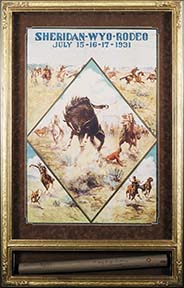
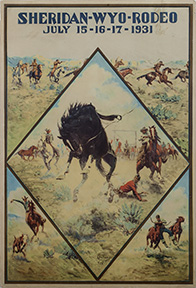
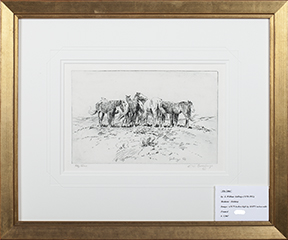
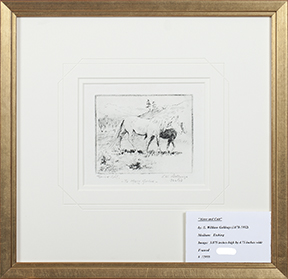
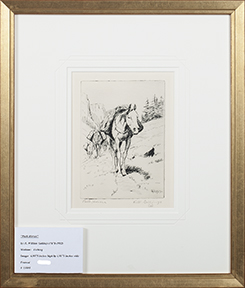
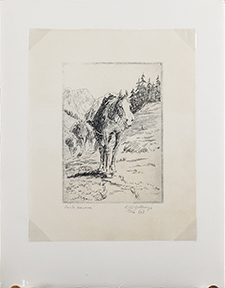
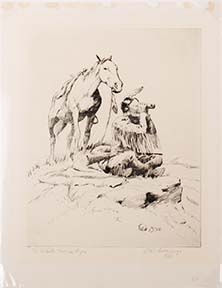
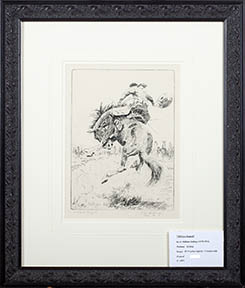
E. W. Gollings a.k.a. Bill Gollings The following article is from Montana The Magazine of Western History, Spring 1965. Paint Bill Elling W. Gollings, Working Cowboy and Unsung Artist, by R. H. (Bob) SCHERGER After the millions of buffalo were wantonly slain, after the Sioux and Cheyenne were subdued and driven to reservations, and after the Civil War had "united" the nation, the opportunity came. It was grass, the same that had nourished the buffalo for centuries, that proved the great welding factor. Some wrote that when the winds blew and the grass bowed to its will, the vast prairies resembled the boundless ocean. Prairie economics were simple: buy cattle at a low price, feed nutritious free grass, then sell on a good market. These ingredients triggered the mass movement of cattle from Texas to Montana in the 1880's. With the railroads piercing the great prairie lands, cattlemen gained access to the rich Chicago market. As a result, much activity centered around the "end of track" and along the historic old Texas trails to the Northern Great Plains. Longhorns were trail-driven from Texas and Mexico with the principal Northern route converging east of the Big Horn Mountains. Near Buffalo, Wyoming Territory, and at what is now Sheridan, these herds trekked along lush river valleys north to the Yellowstone River in Montana Territory. The Buffalo-Sheridan area proved a natural division point, for nearby originated the headwaters of three famed cattlemen's rivers that flowed into the Yellowstone: the Rosebud, the Tongue, and the Powder. Each was a prime path leading the great herds to the vast prairies north and south of the Yellowstone River, and the valleys proved natural, protected pastures, plentiful in their natural balance of grass, water and shelter. When the Northern Pacific Railroad reached Miles City, M.T., in 1881, that colorful little cow-town speedily became the hub of a great cattle empire. To the south was Wyoming and southeast lay the Black Hills and the frontier communities of Lead, Deadwood and Belle Fourche, Dakota Territory. On a cattle ranch near the Powder River on the Wyoming side, a little three-year-old girl came to know two cowpunchers, both named Bill. How did she tell them apart? It was simply done: one she called "Blonde Bill"because of his sandy hair; the other was "Paint Bill" because he could paint beautiful pictures. Her mother remembered this long ago incident and related it to me, not long ago. The ranch belonged to Willis Moses Spear, the little girl's father, for whom "Paint Bill" was then a working cowboy, helping with the roundup. "Doc" Spear often remarked: "Bill can paint a horse better than any man I know." His words echo even more strongly today. Here's why: On a visit to Sheridan in 1957 I had noticed several amazingly well-done paintings which vividly brought to life the early horse and cowpuncher days: a Texas trail herd, a winter camp, and a roundup, all done in such a realistic, graphic and spirited manner that I silently marveled. I looked for a signature. It read simply "Gollings," with a little pony track drawn next to it. So it was that I became acquainted with the work of Elling W. (Bill) Gollings. I liked his art so well that I made up my mind to see more and to learn all I could about "Paint Bill." It wasn't an easy job. On a subsequent trip to Cody, Wyoming, I inquired at the Whitney Art Gallery. Did they leave books or pamphlets on Bill Gollings' work and on his life? They had none. Further, the attendant knew little about the artist. This astounded me. Could it be that the distance of a mere hundred miles and one mountain range kept the paintings of an artist of this quality only in one locality around Sheridan? Surely he was worth knowing, and his art worthy of exhibition. These questions were answered in the affirmative. But where are his paintings and the details of his life? "No one here except perhaps ex-Governor (now U. S. Senator) Simpson knows much about him," was the answer. And so I returned again to Sheridan in search of the story of Bill Gollings. I was told that there were many still living who knew him. I approached some of these people, but most of them could give me little factual information about his life, although I did come away with some interesting facets: that Bill Gollings had been a working cowpuncher and a good one; that there were still many of his paintings and drawings around; that he had never cared for publicity or notoriety-in fact he actually discouraged it; and that he died quietly and unobtrusively in 1932. Eventually I visited the Montana Historical Library in Helena, seeking information. They, too, had been searching but without many results. An exhaustive search produced two significant items: a reference in The Rocky Mountain Husbandman, and an article by a Mrs. Marion A. White, editor of The Fine Arts Journal, Chicago, dated February 1906. This was the biggest nugget I had yet found. The account read: E. S. Paxson, C. M. Russell, and E. Gollings are an interesting group of Montana artists, Elling Gollings being the youngest of the three and only twentv six years of age. His paintings are filled with the breeziness of the plains, with spirited delineations of horses and men. It is doubtful if Mr. Gollings himself realizes how good his work is. "I. have much to learn," he modestly says, when one is commenting upon his work favorably in his hearing, "But I understand the life on the horse ranch, and know a horse well, therefore it is easier for me to paint them." Indeed he does know a horse well, the horse of the, Western plains, the half wild fellow before and after he is subdued. Sometimes his landscapes are painted as a mere setting for the animal, or animals, and again we find a fine landscape, stretching away toward the distant mountains, with probably, in the foreground, a bucking pony on which is seated a bold and daring rider, who you feel would never submit to being thrown. Mr. Gollings has done much of his sketching from the back of his pony. One of these animals, "Kid," is quite accustomed to the rustle of paper, and will stand unusually still for a long time. Then when he thinks his master has kept him at a standstill long enough, he shows signs of playful restiveness which is fatal to the efforts of the artist. Mr. Gollings uses his brush with a marked freedom; there is a spontaneity of touch, as if it were a very easy matter for him to express himself in color. His drawing is above criticism and his knowledge of foreshortening good. Many of his paintings have found their way in collections where the collector is appreciative of horseflesh, or where he understands and delights in that which suggests life of the American Plains. Mr. Gollings has lately come to Chicago and is enjoying being a sort of free lance at the Academy of Fine Arts, and as he has a decidedly individual and vital expression in his work, he is not likely to be spoiled by foreign influence and to give up the painting of the themes so truly American and around which the halo of patriotic fervor lingers, for the presentation of windmills, canals, and the like. "So," I said to myself, "he did have some recognition once, but why was it that Sheridan, Wyoming alone knew him, although Mrs. White calls him a Montana artist?" Few Montanans I had met knew him. He was not listed in any biographical reference books that I could find. After much search seeing many people and asking countless questions, I learned that Bill Gollings probably first came to Wyoming from Montana, specifically from the area that is now the Northern Cheyenne Indian Reservation. He'd lived there as a young cowboy, and it was in the Lame Deer area that he had purchased, via mail order catalogue, his first artist materials! In a lonely ranch house a few miles north of Lame Deer, I studied what was reputedly one of his first oil paintings, signed "Gollings" and dated 1903. The subject was a cabin with a stragglv dead tree and a background of pine trees on scoria red topped hills. Going outside, I found almost the spot where Bill 'had stood. I could still see the dead tree; the hills and the cabin were much as he had viewed them 60 years earlier. Not far away I saw the Indian Rock, still a thing of beauty with Indian carvings in its sandstone face. There the young Cheyenne braves had prayed, asking the Great Spirit for a name, a goal in life, and good medicine to carry with them through many moons. Finally, much later, I discovered an autobiography (Published under auspices of the P. E. O. Sisterhood, Sheridan, Wyo., Feb., 1925; reprinted in Annals of Wyoming, (Wyoming State Archives and Hist. Dept., Cheyenne), October, 1932, pp. 704-14.) of this unpretentious cowboy artist. Modestly and quietly he told his own low key story: My memory first took root about 1881 on a large farm in Michigan, near a little town called St. Johns. I was born in what was then the Territory of Idaho in the little mining-camp of Pierce City in 1878. My mother was injured by a fall from slipping and was taken to Chicago for surgical treatment, where she subsequently died and was buried in St. Johns, Michigan. Her maiden name was Tilla A. Howell. I do not know her birthplace, but her people were long residents of Kentucky. My father's name is Ellick H. Gollings, and he was born in Norway in 1842, coming to this country in 1844. There were three brothers, all older, in our family. They were Howard M., Oliver W., and DeWitt Clinton Gollings. After my mother's death we were taken in charge by my grandmother, then a comparatively young woman, who was married to the owner of a large farm in Michigan. This was her second marriage, as her first husband died some years before. All the spare time that my brothers had, and they seemed to have a great deal of it, they spent in teasing me. Naturally I did the crying for all four, but between tears, I found time to store in my memory a world of recollections well worth the trouble to carry around. I remember that there was everything on this farm-horses, cattle, ducks, geese, screeching guinea-hens, peacocks, pigs, and sheep. There were also hired men who took a hand in teasing me. On this very large farm, also, there was the most wonderful dog in the world. He could go off in the deep-wooded pastures and bring in the whole herd of milk-cows all by himself and never miss a cow. I have often used this dog for a pillow to take a nap on through the noon hour. It would take pages to describe this farm and all that went with it and perhaps I would not mention it at all had it not been the place where my memory starts. Nothing goes on forever, and so with this farm. My grandfather had met with business reverses through law-suits and underhandedness of some disreputable sons by his first marriage, and consequently the farm vanished in reality, but not in memory and a new vicinity loomed up, Chicago. My recollections (of) Chicago never interested me; and how long I was in Chicago this time, is not clear. I do remember entering school but not learning anything. Our stay was short and ended with the death of my grandfather. Then my grandmother and my three brothers and I went to New York State to a little town about one hundred miles from Albany, called Cooksockie. We lived with an old maid relative of grandfather's, who had a farm a mile or more from the village. She was a spiritualist and heard rappings all the time. During the cold weather, when the first frost popped the trees ;and nails in the house, the rappings were continuous. My brothers and I attended school here. I remember the school and the country about that we traversed, but do not remember learning anything except from my older brothers, who knew how to make figure four traps and to set them for muskrats which were plentiful. . . They also could make bows and arrows and sling-shots and could shoot them. These things I learned and it was all at the time that I needed to know. They often told of their experiences in the west at the mines, and as they were old enough to read adventure books they kept me thrilled with possible adventures of the future. They often talked of guns and how they wished they had one, as there were plenty of foxes in New York, and one could see them running along the stone-wall fences in winter or crossing the fields. Our New York visit drew to a close. We had been there about a year. Leaving the spirits with the old-maid relative, we took the train back to Chicago. More schooling took place at a boarding school, but not for long as my father had remarried and sent for his flock. Grandmother with. many regrets and tears put us four in care of a man who had invented some new blasting powder and was headed for the west to my father's mine to try out the explosive. This was a long trip in those days (the Northern Pacific had not been built yet as this was in the spring of 1886) in fact, it was so long that eventually the train seemed like home just as a covered wagon might seem like home after thirty days or more on the dusty trail. However, our train trip was only five or six days long. I do not remember any excitement during this trip, but events and surroundings were so new, I imagine my eyes and mouth were open a good deal. Through western Dakota and Montana territories there was certainly a lack of settlements, compared to the present day. Even in 1898 when I once more roamed along the Yellowstone River (of which I shall write later) there were no settlers. The country was in a virgin state for miles and miles, only a section house or water tanks to tell of civilization. Occasionally a herd of cattle or horses could be seen; and once a dark object away off on a flat was said to be a buffalo. It no doubt was, for the last of the buffalo was killed as late as 1887 along the Yellowstone. This the settlers told me later. I do not know to this day where we left the Northern Pacific train and have never inquired. But we landed at our destination, Lewiston, Idaho, at a steamboat landing.. We came up the Snake River by steamboat, a stern-wheeler, as she was called. Lewiston lies at the junction of the Clearwater and Snake Rivers and was an old town then, full of interest for four boys from the East. If my eyes and mouth were open on the Northern Pacific train, I do not know what my expression was here, for there was surely more to see. The town was literally full of Indians of the Nez Perce tribe. At this time there was some kind of an adjustment through the Interior Department at Washington with these Indians. Probably a money settlement and they were either in town to spend it or get it. Whichever way it was it was a sight worth seeing. Not the unkempt poverty stricken Indians we see today, dressed in cast-off white men's rags or the poorest working clothes, but bedecked in the most gorgeous colored blankets, faces painted, beautiful beaded buckskin garments and lots of their old time finery. They were mostly bare headed, but occasionally a war bonnet was seen or a buffalo horn head dress. Their ponies were the pure Indian pony as there had been no draft horse blood mixture with their ponies of those days. The only blood that might have been infused would perhaps be that of a race horse, brought to the coast by the early Oregon emigrant, who had come in numbers in the sixties and seventies. All of which would not have materially changed the build of the most perfect pony in the world-that of the Indians. Besides the Indians in the town there were also Chinamen, Spaniards and white men. I mention the white men last as they were the least interesting. I had seen them elsewhere. All western towns at that time had a Chinatown and Lewiston was not forgotten, for they were everywhere to be seen in all manner of occupations. The Spaniards were not many in number, but were a distinct type and chiefly followed the "pack train" industry. There were few wagon roads in the country and supplies to the mines and out of way ranches were packed in on mules. Seventy or eighty mules constituted a train and a train was usually owned by a man of affairs in town and operated by a couple of Spaniards. Chinamen were largely in this branch of business, generally supplying Chinese miners and store keepers of other districts. The "train packing" industry was so extensive that it influenced the dialect of the natives for none used the word "carry" but substituted "pack" in all cases. Previous to our coming west, my father and step-mother had taken up ranch homesteads adjoining each other six miles east of Lewiston on the Clearwater. river. Here was to be, our home. I missed my grandmother a great deal and was not very well acquainted with my father, having seen him once before that I remember, when he came to visit us one Christmas in Michigan. The promise that I was some day to have an Indian pony of my own, made up for a lot of parental affection. Here I made the acquaintance of my new mother and her two daughters, Alice, who was my own age and Etta, who was younger by a year. Afterwards, my father had by his second marriage three children; they were Chase, Harry and Aletta Gollings. These new relatives proved to be very nice, and companions worth having. In due time I had my pony, as horses were a drug on the market, and everybody had some. Many had hundreds. We. had but a few, but they were better than the average range horse and were spoken of as American horses. Anything that was above pony blood or cayuse, as they were termed, were called American horses. The summer passed and fall came with the heavens alive with wild geese and ducks. One could hear the honking of wild geese all night during the fall. Winter followed and a short one in that country. We had school on the ranch. My father had mentioned being a school teacher when a boy in Minnesota. but we just listened; before spring we were sure he had been. There was no school in the country, although along the river the settlers were quite thick. There were many families whose children could not read and write. But my father had different ideas for his flock; consequently we went to school and I remember learning. This first winter on the ranch I took an interest in drawing. I did not do it myself, however. My brother, Oliver, the next to the oldest, could do anything, it seemed to me. Among his many accomplishments was the ability to draw a horse in outline on a slate. Then he would put on a saddle and bridle. This ability fascinated me, but I did not try to do likewise. Those simple drawings, sometimes in colored pencil, stick in my memory as clear as any memory I have. Certainly they created in me a desire to draw. But I had no idea of how to do it. The winter passed and another 'and the third winter we moved to town and went to school. Father now had some mechanical ideas he wanted to carry out, but lack of constructing machinery in that country caused him to plan to go east. Consequently, he disposed of his mine and the following fall saw us on the train headed east to Chicago again. I was not happy; but I had no say in the matter. We soon had all the boys in the neighborhood throwing lassos and playing cowboy. And the years that followed, each and all had so many plans laid of how and when we would go back to the Territory of Idaho. Why should we not go? There was everything there that we wanted: horses and cattle, Indians and cowboys, a river to swim in and fish in, good hunting and no game laws. We had seen just the things that thrill a boy. There were old prospectors who had been forty-niners and who carried a cap-and-ball six-shooter wherever they went. There were men left from the trapper period, whose only clothes had been buckskin and fur. Indian manufacture, of course. We had seen "jerk line" freight trains, flying stage coaches of the old type, with six horses in a harness all beringed and polished, and the driver the proudest man in the world as he sat on the boot with his gauntlet gloves and big hat, which belonged to the stage driver alone. We had seen a pony war dance given by the Nez Perce Indians at Fort Lapaway [Lapwai], a spectacle never to be repeated; little did we know it then, however. Then there were the pack trains, Chinese funerals and New Year's festivities. Thinking of these things, Chicago did not amount to a great deal. Nevertheless we were doomed to stay for a time. We went to school and I learned perspective as it was taught in the schools, and took a real interest in drawing. About this time Frederic Remington was illustrating for Harpers magazine, and had been since 1889. 1 was much taken with his work and was sure to see all that was published. Most of the engravings of that day were on wood; the half tone process had just begun to be used and many of Remington's things were wood cuts taken, of course, direct from his original drawings. In the spring of 1893, I had my lank form photographed in a new suit, with a diploma in one hand and a straw hat in the other, along with the rest of my class. The diploma said in beautiful writing, that I had been through the eighth grade in Chicago Public School's measurement. I never used the diploma. I have seen it a couple of times since, but did not unroll it, It is the only one I ever received and if I never get any more use out of any I ma3, get in the future than I got out of this one, I will not need them. During the next three years, I worked at an assortment of jobs, such . as a boy might run across. I was a bell hop for a short time during the World's Fair, delivered groceries, worked in a drafting room making blue prints, worked on farms (the hardest work ever laid out for a man to do). On the farms, immediately after supper they lit a lantern and put in the night; they went to bed long enough to muss it up so that whoever kept house would not run out of something to do during the day. I fired a switch engine and worked with a construction engineer. One early morning in August, 1896, I woke up in a chair car rolling across the plains of western South Dakota, together with a boy chum who also had the western fever. Our tickets read to some small place which was a shipping point south of Rapid City. They were stock-pass return tickets, so we were under assumed names. They carried us on to Rapid City, where I took my real name back as soon as I stepped off the train. It worried me to have that awkward name hanging to me. To make matters worse, I had practiced writing it and saying it over in my mind (in case we were questioned by the conductor) until it hung to me almost as strong as my own name. Our ambition now was to get a job as we did not possess a great deal of ready cash, myself less than my chum. We hoboed back down the line to Chadron. This was the first time I had ever beaten my way and the last. There was nothing to do in Chadron and so we went on to Alliance, Nebraska. There was nothing but a hot wind blowing there, so we went on to Marshland, a desolate place. Here we bought a couple of horses and headed north. This seemed like real life, astride a horse and the Arctic Circle ahead of us. It did not take much to live, lots of the ranches would not take pay for food and a hay mow in a livery barn afforded a wonderful place to sleep. We stopped at all the towns on the Northwestern. Many of them afforded good amusement for boys our age. They were typical western towns. In Oelrichs, South Dakota, for instance, the cowboys rode their horses into the saloon and took a drink, not necessarily to show off, for there were not many to show off to. There were no easterners to scare, but ourselves, and I did not consider myself a tenderfoot and my chum was well coached. Often men were seen with six shooters on their person. They wore them in a very matter of course way, as if it were part of their dress. There were cowboys well along in years who had spent their lives on the prairies and had dressed thus all the time. This country was not Idaho, but a good substitute and I was satisfied. We spent the time pleasantly drifting north with no special point in view, but the end of the railroad held an alluring charm. Deadwood, South Dakota finally loomed up, then Lead City was visited and then north to Belle Fourche. Here our first job was digging potatoes. We worked until snow flew. Belle Fourche at that time was the largest shipping point in the world. The country north was the greatest cow range, where steers mostly rail shipped from Texas to Mexico ran the range. Trailing from the South was mostly over in those days as it was cheaper and quicker to ship them by rail. Big cow outfits were much in evidence, some running as many as six roundup wagons. It made Belle Fourche the most typical cow town in the north. Gambling was wide open and every saloon was a gambling house and there were many of them. I must say here that Belle Fourche up to perhaps 1897 carried more of the spirit of the old west than any town in the world. The gambler type, the grim dusty riders of the range, the hitching racks lined with cow ponies and an occasional Chinaman. The dance halls and the shooting up of the town are all sights I am glad I have had the opportunity to see and remember. One other sight that fall worth remembering (as I have reason to believe it has never been seen since) was a bull team, such as had done the freighting into the country in the years previous to the coming of the railroad. The trail for hauling freight ran from Deadwood to Hardin (a post office and store on the stage line north of Belle Fourche about eighty or ninety miles). This was the last trip this train was to make, I learned later. I came upon this sight as the wagon train was camped for noon on the Red Water river. The bull-whacker seeing that I was interested, said, "Howdy" and asked if I had ever seen a bull-train or heard a bull whacker swear. To both questions I answered "no." "Well, kid," he said, "you stay here until I get to the top of this hill and you'll hear something new." I did not need to be asked to watch him pull out, the sight was interesting enough to hold my attention. So I sat my horse and watched him yoke up his eight yokes of oxen and then move. He certainly told the truth, for, besides calling these sixteen head of cattle each by name, apparently in one breath, he introduced one cuss-word after another, until the air was blue with phrases-all new to me. He finally passed the top of the slope that led down to the river and thus passed into history as the last bull-team of that section. My chum and I had separated and our outfits sold. I bought a few winter clothes. I spent the winter in the little deserted village of Minnesella. The railroad had passed it by and had established the town of Belle Fourche. Work was hard to get and I was glad to earn my board carrying mail to a mail post on the railroad a mile and a half away. I wanted to paint now; it grew to be a strong desire, but I had no colors nor opportunity. I did, however, make some little pencil sketches and modeled some horses' heads in laundry soap. The natives thought I was wonderful. Spring came and I wanted to punch cows, but I had po outfit. I took a sheep herding job ninetv miles north of Belle Fourche. By September, I had enough money coming to me to have a tooth pulled and buy an outfit, which I did. Straightaway I got a job with a cow outfit in the Slim Buttes country. All this country was worth living in; there were antelope in abundance on the prairies and deer in the hills besides wolves and coyotes aplenty. It all seemed a paradise. The whole country seemed to belong to the cow outfits alone;, there were very few sheep and horses and the grass waved over all this land. I spent the winter herding a thousand head of cattle along with some cowboys from the famous old Turkey Track outfit. We fed in bad weather as this winter was long and cold. A blizzard struck us in March. I have experienced many winter storms in the west, but none have compared with this. For thirty-six hours the snow blew and swirled so fast and furious that one could not see anything distinctly ten feet away. I shall leave it to some good writer to properly describe a blizzard. Certainly the people who live in blizzard country are the only ones who know what it means. I have heard many storms since called blizzards, but I could not, in truth, call them such. I struck out after the storm for Montana. The drifts were deep and the going slow. More storms followed and I was forced to lay over at different places several days. About the 15th of April, I turned my pony loose at a ranch on Rosebud Creek near the Yellowstone River, after three hundred miles of travel. Here my brother DeWitt, just older than 1, was located, having left college some time previously. He staked me to a fresh horse and I rode forth to hunt for a job. There were two alluring forms of excitement in the atmosphere at this time: the war with Spain and the Klondyke gold rush. Neither one appealed to me so much as a chance to ride the open range. I realized the cowboy days were about over. The older men in the game told me as much. Yet I longed to see and be a part of at least the last of it. Besides there was nothing picturesque about a cavalryman, and I did not need the yellow metal. So in the years that followed I rode the range and worked on a ranch, or drove stage, or trapped in the winter. Cattlemen at this time had begun to feed their stock in the winter to a large extent so that a rider practically rode the year round. The only difference being that one worked from ranches in the winter and a round-up wagon in the summer, although I have worked from a wagon in the coldest part of a cold winter. Once in awhile during these years, I longed to paint, but the free open life I was leading held me fast. In the early spring of 1903 I sent to Montgomery Ward & Company for some oil colors and other equipment to paint with. When the snow went off I made a few crude attempts at picture-making. The people on the ranch where I stayed and called home thought them wonderful. That summer I covered the mess tent with charcoal studies; horse heads and certain characters who worked with the wagon. My brother had taken some of these first attempts to Sheridan, Wyoming. Mr. W. E. Freeman, in a furniture store, became interested and asked my brother to bring me over. The following spring I came over to Sheridan with my brother, who at that time had certain interests there, and brought my paints. We stayed a month and I made several pictures while at the hotel. Mr. Freeman put them in his store. He said he would sell them. I went back to work on the roundup, as usual, with no special thought of pictures outside the fact that I did enjoy creating them and told myself that I would do more in time to come. I was working with a horse outfit, said to be the largest in the world. I believe it was. In July we had just worked a herd and shipped and were about to get out and gather another herd, when a letter came to me from Mr. Freeman with a check for fifty dollars enclosed and the advice that I had better make some more pictures and send them as he felt he could sell more. I was bewildered; I hated to quit the wagon and leave my string of horses for someone else to ride. I felt an injustice being done me from some source, but it seemed above all that I should do it. So I bid my pony and the boys goodby, went back to my adopted home and went to work; not all picture making. I did not feel I could devote all my time to that. So I broke some horses for my brother, rode line on the Cheyenne Reservation fence, and painted. The Cheyenne Reservation fence had not long been built. The white man's cattle had been taken from the Reservation (their old range), and put outside. They naturally worked back to the fence. The Red-men liked to eat the White-men's cattle so it was up to the ranchers to keep their stock back from the fence. I gladly did it, and the ranchers were glad to have me do it, as it saved them time for their ranch work and the loss of several head of cattle. I made four or five quite large paintings by the time snow flew, along with my other work. Now my brother thought it was time for me to branch out, so he sent some of these pictures east for inspection. Mrs. Marion A. White, then editor of the Chicago Fine Arts Journal saw them and gave me a writeup. She said that I should come east and study. My picture money and my wages had been spent for a new horse, equipment and a hair cut; how was I to go east and study? "I will stake you, " says my brother. Accordingly I took passage on a stock train and landed in Chicago, expecting to start school very soon. I sent for money to start on. My brother by over speculation had broke himself. I had an opportunity to paint myself to freedom; not a very bright prospect at best. I made a couple of pictures now that will always be vivid in my memory, for I sold them for two hundred dollars. The man who bought them had been in partnership with my father in his gold mine. This man was manufacturing the Miehle printing press, the only press at the time that would register accurately enough to print color work. These pictures were reproduced by his press at the Portland Exhibition as an exhibit of the press's ability to reproduce color work. The sale of these pictures now gave me a chance at school, The Chicago Academy of Fine Arts. I went two months, at the end of which I was informed I had won a scholarship in composition. This announcement bewildered me as I felt it was too good to be true. But it was, for it came out in the Chicago papers with a picture of someone else labeled myself. Spring had come. I wanted to go back west, but had no money to go on. I showed some men in the general offices of the Burlington Railroad a picture, making them understand that I was willing to trade the picture for a pass to Sheridan. The men were interested, asked a lot of questions while one of them wrote something on a ticket as long as a bridle rein and handed it to me. I thanked them and boarded a train for Sheridan, where my brother met me full of enthusiasm for my future. I wanted to go right back on the roundup, but he argued me out of it. But I won out that fall, for I was riding a string of horses for an outfit in the northern part of the state, where I got fired for handling a bucking horse too rough. I went back to painting for the winter, sold my outfit and resolved never to ride again. Once in a while I sold a picture. The following spring I had another outfit and a job riding: taking a bunch of bulls to the Cheyenne Reservation. I was among home people again, for the Cheyenne knew me well. But I was not quite satisfied; the old job was losing its charm. I drifted back to the painting. game in a half-hearted way. The following winter I took two more months of study in Chicago Academy of Fine Arts on my scholarship. It seemed good to be in school, and I advanced a great deal. Finances were always short, so school soon let out for me. I came back to Sheridan. I painted hard until summer then the old fever returned. I still had my horse goods. I relieved my mental worries by helping a horse buyer get a bunch together to ship. This stimulated me to get another job. Again I found myself on the Cheyenne Reservation running the beef-issue job for the cow outfit that had the contract. This beef-issue job ended my riding for wages. I determined to quit for good and paint steadily and have kept faith with myself to the present day with the exception of occasionally helping for a week or two some stockman who happened to need extra help and asked me to. Each summer or nearly so, I'd go to a roundup wagon and staying a week or so each time, work just for the recreation and fun I'd get out of it. My inability to get down to [art] work seriously, I have never been able to explain. While I wanted to and knew that some day I would do so, nevertheless I was always easily influenced away from my work to visit different ranches, taking my colors with me of course, but practically doing nothing. I never did get settled to work until February 1909, when I built a shack and called it a studio. (The skylight in the roof gave me the right to call it such.) I had met and talked with a few of America's foremost painters: H. H. Sharp, Howard Russell Butler, William B. Henderson, C. M. Russell, Frederic Remington (now dead) and a few lesser lights. They have all had a good influence on my work. My work has had a good distribution throughout the United States and even in foreign countries. Four of my pictures are in the Wyoming capitol at Cheyenne: "The Smoke Signal...... Indian Attack on the Overland Stage...... Emigrants on the Platte," "The Wagon Box Fight." I have no pictures in permanent galleries. I do not consider the others worth mentioning. Work for the rest of my life is ahead of me with only one thing that would ever take me from it; to be younger and have the country open and unsettled as it was when I first made riding my profession. This is the way Bill Gollings viewed his own life, up to February, 1923, when he penned this unadorned account. Later a terse diary covering the period 1912 to 1915, was found. Brief as it is, it reveals more of his feelings, trials and tribulations as an artist, than does his longer and later biographical sketch. Excerpts from Bill's diary will help us understand this quiet artist better: -1912 - April 8: Worked on picture of fellow running bunch of horses which I've had on my easel for past week. Has been very warm today, uncomfortable in my shack. Tonight has been warm and balmy. Frogs singing. April -9: Went to picture show. Sent picture away to Osborn Company today, "Getting Tangled." Posed for portrait study. Made a study using yellow ochre, mineral blue, and alagrine crimson and got pleasing results. April 13: Its so dark I can't work in oils. Have made pen sketch for fellow in Basin of our trip last summer. Made Indian drawing yesterday. April 14: Am remodeling trail herd picture today. Meadowlarks singing nicely. To dentist again today. April 17: Got first gold in teeth. Lost two games poker. April 22: Worked on picture of wolf and snow scene. April 25: To Chet and Lucy's for supper. Worked two days on trail herd picture changing it and don't seem to compose very satisfactorily. "Doc" (Spear) was down and took me to town in car. April 27: Walked home with Maudie tonight. April 29: Wolf hunting with Ben on Reservation. April 30: Went to John S. Taylor School Art Exhibit. Pleased. May 4: Finished cover for the Western Trail Magazine this A.M. Brooks has accepted it. May 6: Made sketch and colored another to submit to Western Trail Magazine. May 10: Working over "A Talk to the Sun." Played a little twenty-one. Arm sore-played ball some yesterday. May 12: Delegation from Congregational Church bought picture for Chaplin Axton from the fort. Went to picture show alone. Ate dinner with "Doc" Spear, working on Elk cover for Western Trail Magazine. May 15: Took Nell to show. Showed Brook cover design last night and he accepted same. June 10: Have worked on a stunt called "Recollection of a Fighting Chief," an Indian history picture. Two days ago awful flood in Buffalo (Wyoming). June 23: Sold wolf picture called "Watching." Was snow scene. Lonesome today but working. Maude spoke to me yesterday. Still on "Recollections." June 24: Finished Indian picture. Took Maude to show. June 28: Donald Coffeen staked me to a horse to go out to Aldersons. June 29: Circus today. Monterief's friends, the Gallatins bought a sketch. June 30: Cleaned house, preparing to go to Birney. Boxed picture for Denio. July 7: Am reversing my last Indian picture. July 14: Worked on Indian picture all day. July 27: To Big Horn for dance. August 6: Received ten dollars for picture made at Aldersons. August 7: Saddled up seventy or more horses at Eatons. Helped Cubby and Harry. August 8: Colonel Hall bought two pictures, two watercolors. Wolves and man on herd in snow storm for thirty dollars. Last night we all had a little party. Lost a little fifteen dollars. August 14: To Dana's by way of Dayton and Parkman. Sold picture to Wainwright for two hundred dollars. Went to Parkman with a fast team and a sick man. Got trunk and materials. Made sketch of mountains. Enjoyed Mrs. Dantt's books all evening. August 18: Got in to Sheridan at one o'clock. Sent to New York for easel. The first good easel I will have owned. September 3: Went to town from Dana's. Sent landscapes to George Levi Smith. September 13: At Dana Ranch. Hunted chickens, played cards, am not crazy about leaving here, only to get back to work in Sheridan. September 18: Fair at Sheridan. The Kirby opera house has been made into an exhibit hall, and I have pictures there that were done at Dana's (ranch). They are in with George Levi Smith's exhibit of handmade furniture. Today saw first aeroplane flight in my life. Have met the bird man and was filled with wonder as he and machine went into air. He made two flights. Am blue and lonesome. A certain girl's spirit seems,to envelope me. Nothing can be done to right all that is wrong between us. I fussed over my new French easel today which came from New York, and was here on my arrival home. This is a long-felt want fulfilled. Believe it will give me heaps of pleasure. September 30: Started composition called "The Blanket Signal." (Artist) Sharp came through Saturday. Bert and I were there to see him. Have four landscapes done at Dana's in Kay's window. Carl Tarbox sold couple of pictures for me at the ranch. They will amount to fifty five dollars. October 4: Sharp came down from Crow (Agency). I was at Birney (Mont.), made three sketches. Hunted and went to Three Circle and Alberts. Went down on stage and came back by Lodge Grass riding horse to "Forty Mile" to ship to Tilletson at Omaha. October 21: Saw brother DeWitt on films at picture show two nights. Weather clear. Frosty nights. Finished original for "Blanket Signal." October 25: Put one hundred twenty-five dollars in bank. Made drawings for picture called, "Hidden Trouble." Started oil copy of landscape made at Birney, with figures of squaw and Indian horseback, crossing river in foreground. November 15: Started three evening scenes. Teepees, brush on river, horses in foreground. Am nervous and troubled a great deal. No peace wlth Maude. November 24: Started "White Medicine Man." November 29: Took Millie to hear violinist. Sold "Hidden Trouble" to Gerlach Bunklow for a song. December 10: Doing "Fear of the Great Spirit." Robert Carr the poet wrote. Herbert Coffeen died. - 1913 - January 1: Got to Chicago. - 1914 - April 23: Sent two charcoal jokes to Life (magazine) - April 26: Have started, "A substitute for Buffalo." Nearly finished John Stout's picture for his girl. April 29: Painting steady. June 13: Sheriff Veach was killed today by a horse thief. September 1: Got my boots from Hyer. Their number is 117318. - 1915 - February 15: Have worked a heap since I came from the South in October last. Am working with Maratta colors now and they seem to bring me to color easier than other colors. Sharp was here not long ago and criticized my color more than anything else. Says my drawing and composition are good, if I could only get my color to pull together. March 18: Mable had a birthday party, as usual, for me and herself. Roy, his wife, and Harry were there. Have waited for money that's coming till I'm about crazy. I need it badly. Red Wing turned two of my late things. Thats all I've sent out lately. Maude is still at Sundance. March 25: Am making a couple of things with action to submit to Mr. Peckenpaugh. Heard from Karl Burchhardt, he wants some stuff sent down. Sent Maude some things Tuesday, a bracelet and correspondence cards. Have money coming in but can't get it and have been flat broke for some time. The Maratta colors seem to work very good.,. Am doing much better colored work. March 27: Have finished two pictures, both of action. Am very short on material. March 30: Sending five pictures to Karl Burchhardt, also getting DeWitt to send one from Chicago, "Breaking Thru." Others are, "Busting a Steer," "Surrounded," "Dragging it from Him," "Turning the Lead," and '.'A Bear Possibility." April 1: Got fifty dollars from "Doc" this A.M. Sent pictures to Cincinnati, and for materials. Guess I would have hell sometimes without Doc. Have waited a long time for money that's coming from Santa Fe Railroad, and Adams Express Company, but it don't come. April 13: Working on moonlight scene today. Yesterday and today have been very warm. Looked like rain most all day. This evening it lightened some. Heard a crow caw today, no meadow larks yet, and the Tree Toads sang last two nights. The diary ends. Perhaps it was too much "work" for this frustrated cowboy artist. But you'll note the references to his yearning, unrequited love. Here is the later story, laboriously pieced together from countless personal interviews. It supplies the missing pieces in Bill Gollings' enigmatic life: Maude M. Scrivner was an attractive Western girl of 18 in 1907– gay, intelligent, and possessed of a genuine wholesomeness that bespoke her upbringing on a ranch near Spearfish, S. Dak. Shortly after her elderly parents moved to Wyoming, she went to work in Herbert Coffeen's book store at Sheridan. It was particularly attractive to her because she loved to read. When tourists or some of the early dudes were not around, Coffeen's was a center of activity for cowmen and cowboys. A marriageable girl in those days was a stellar cowboy attraction. They visited, laughed and joked with her. Bill Gollings came too, because his paintings were displayed there for sale. So for several years he saw much of Maude Scrivner. The western ranch girl and the modest, self-made cowboy were in love and this love was not to have an easy road. They quarreled. They made up. Maude always 'tried to show affection, but, only enough to make him notice. She never let him feel she was his. Maude was considered a good woman. She had many friends around Sheridan and up in the Birney country of Montana. Occasionally she rode north into Montana with friends and stayed with those she enjoyed. They laughed, gossiped, and secretly enjoyed the cowboys' attention and gallantry. To Bill Gollings Maude remained aloof, although she was in his heart. They met and chatted, or quarreled. They sometimes avoided one another, but always the feeling was there. Perhaps it was female intuition that kept Maude from immediately marrying Bill. Perhaps it was a subconscious fear, developed when she noticed the pittance he received for his beautiful paintings. He often gave paintings away. The inner urge to express himself always seemed to overwhelm his value or disdain for money. Appreciation of his paintings all too often was the only reward Bill Gollings received, and he was satisfied until the bills became too heavy. Then he sadly realized his dependence on money. Finally on January 29, 1919, after knowing each other nearly twelve years, Maude and Bill were married. It was simply done in a little church in Sheridan. They went to live in a small house next to his studio. Some of their friends said, "It's about time!" But others wondered if it was the right thing to do, "Were they really meant for each other?" She was thirty, Bill was forty-one-set in his ways and moody. "Bill was a tall, good-looking man. His hair was dark, eyes blue, and he dressed as the cowpuncher he was-never without boots or wide brimmed hat. He was a dignified person, stubbornly independent, with a keen sense of humor. He lived to himself, but he was friendly enough to everyone," states a close friend. The Gollings lived together only a few years when they realized their personal problems were insurmountable. Bill's temperament could not be-altered; his lonely way of life could not be changed, and so they separated. Maude moved to California, living there with a widow friend. It was not until nine years later that they were legally divorced; neither ever remarried. CONCLUSION Bill Gollings labored as an artist from 1903 to 1932, a period of twenty-nine years. When he died his small studio held approximately 182 oil paintings, both finished and unfinished, along with a multitude of etchings. It is difficult to ascertain the total amount of art and illustration he produced, but it is generally conceded that there may be a thousand in existence. Gollings' works are rare and generally not for sale, because those who own them cherish them not for the subject matter alone, but almost always because of a close personal tie with the artist himself. One work was aptly described by the editor of the Sheridan Press: When the sun is shining, and the sky is blue and the bunch grass is tall and green, and the sage brush has taken on a gray green hue, and the distant peaks assume that elusive heliotrope shade then fill up the foreground with cowpunchers, cow ponies, cattle, mess wagons, and other things that make the picture truly Western and then you've got it, just as Gollings gets it. The Western flavor of it, the absolute truth of it, the correctness of detail, and the all else of the almost living, breathing broncs and punchers. His Wyoming and Montana friends, in mid-April, 1932, read this account in the same paper: GOLLINGS, NOTED WESTERN ARTIST SUCCUMBS HERE Elling William Gollings, more familiarly known to his friends from coast to coast as Bill Gollings, died following a heart attack early Saturday morning in his room at the Western Hotel. He had been ill less than two weeks and .death came suddenly. He was fifty-four years old. Ranked among the nation's foremost western artists, Gollings achieved nationwide fame through his oils and etchings depicting western life. Four of his outstanding works hang in the halls of the Wyoming capitol at Cheyenne, while others may be found in art galleries in many of the country's large cities and even in Europe.... Virtually all of his pictures were painted in his tiny home at 847 South Sheridan Avenue, a one-room unpainted abode that served him both as studio and living. quarters. Thus this talented man, who seemed to wish anonymity, died alone. He was recognized and loved by the small coterie of admirers, mostly in his home area, but his talent and worth has finally emerged far and wide, not because he willed it himself, but because his honest art has spoken so eloquently for him. ******************************* The following are excerpts from an article in ART WEST, Summer 1978,
entitled "E.W. Gollings, 1878-1932, Last of His Kind" by James T. Forrest. |
||
|
From time to time we offer select and very collectable
works by E. W. "Bill" Gollings. Please contact us about works
that are currently available. Our clients prefer to have works that
are fresh and not shop worn on the market. Simply E-mail
us or call us at 1-800-727-3949 and we will provide you with a link
to your private viewing of works currently available by E. W. "Bill"
Gollings. |
||